
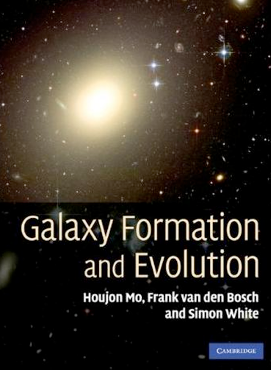

The rapidly expanding field of galaxy formation lies at the interfaces of astronomy, particle physics, and cosmology. Covering diverse topics from these disciplines, all of which are needed to understand how galaxies form and evolve, this book is ideal for researchers entering the field. Individual chapters explore the evolution of the Universe as a whole and its particle and radiation content; linear and nonlinear growth of cosmic structure; processes affecting the gaseous and dark matter components of galaxies and their stellar populations; the formation of spiral and elliptical galaxies; central supermassive black holes and the activity associated with them; galaxy interactions; and the intergalactic medium. Emphasizing both observational and theoretical aspects, this book provides a coherent introduction for astronomers, cosmologists, and astro-particle physicists to the broad range of science underlying the formation and evolution of galaxies.

Hardback, 840 pages
160 illustrations (B/W)
Size: 247 x 174 mm
Weight: 1.77 kg
ISBN: 978-0-521-85793-2
Publisher: Cambridge University Press


Synopsis
Details
News
Sales worldwide top 2000
Figures from book now available for download
Sales worldwide top 1000.
Book wins 2010 PROSE award
Book on sale at Cambridge University Press

Aug 2013 Mar 2012 Apr 2011 Feb 2011 May 2010
Prizes may vary from vendor to vendor

Order your copy

Unfortunately, no major textbook is entirely free of errors, and ours is no exception. Please use the links below to either report an error, or to download a pdf file with all known errors and their corrections. If browser does not support e-mail, please send e-mail with subject `ErrorReport' to hjmo [AT] astro.umass.edu
Errors in First Edition

Reviews
``Mo, van den Bosch, and White have written a comprehensive text on the modern subject of galaxy formation and evolution. The book is fully self-contained, covering the basic theory in depth, and including the essential background material on observations and the relevant theory from extragalactic astronomy, stellar astrophysics, and cosmology. It will serve as an indispensable reference for students and researchers alike, and is destined to become a classic in this field.''
Robert C. Kennicutt, Jr.
Plumian Professor of Astronomy and Experimental Philosophy
Director, Institute of Astronomy, University of Cambridge
``Unraveling the origin and growth of cosmic structures, from the simplicity of the Big Bang to the complexity of the modern Universe, is an unparalleled achievement of modern science. Written by renowned world experts, this book presents a clear, systematic and comprehensive exposition of the physics and mathematics underlying these breathtaking advances. It is compulsory reading not only for those aspiring to contribute to our growing understanding of the cosmos, but for all those who appreciate the beauty and power of contemporary physical science.''
Carlos S. Frenk
Ogden Professor of Fundamental Physics
Director, Institute for Computational Cosmology, Durham University
``[...] this text breaks new ground in being the first comprehensive review of our present understanding of galaxy formation. [...The book] presents and explains rigorous mathematical models of everything from the evolution of stellar populations and chemical enrichment to the hierarchical growth of structure from cosmological perturbations. [...] Every topic is extremely well referenced and current (citing approximately 1500 research papers and books with a median publication data in the mid 1990s). This book is likely to be an essential reference for any galaxy-formation-research student or professor. In the coming years I can see myself dipping into this treasure trove on a very regular basis.''
Shaun Cole, in The Observatory, Dec 2010
Professor, Institute for Computational Cosmology, Durham University
``Galaxy Formation and Evolution by Houjun Mo, Frank van den Bosch, and Simon White is an ideal introduction for anyone with a minimal background in astrophysics who wishes to enter the field of large-scale structure formation. It is well suited for use in a general astrophysics course for senior- undergraduate and graduate students and is also an excellent reference source for more advanced courses on specific topics in astrophysics. The authors are leading theoretical astrophysicists who have made major contributions to galaxy formation theory. Their text provides a comprehensive review of relevant topics, ranging from the growth of the first density fluctuations to the evolution of the stellar populations in galaxies.''
Joseph Silk, in Physics Today, July 2011
Savilian Chair of Astronomy, University of Oxford
``Although there are several excellent textbooks in the area, I firmly believe that this one will become the standard reference in the area. The breadth of the topics covered alone would make it shoot up to the ranks of the top, and when one factors in all the detailed calculations and results that are presented to make the book wholly self-contained, it is easy to see why this book deserves to become the definitive work in galaxy formation and evolution.’’
Customer Review, Amazon.com

About the Authors

Download contents



Houjun Mo is Professor of Astrophysics at the Universiy of Massachusetts. He is known for his work on the formation and clustering of galaxies and their dark matter halo.
Address: Department of Astronomy, University of Massachusetts,
710 North Pleasant Street, Amherst MA 01003
E-mail: hjmo [AT] astro.umass.edu
Frank van den Bosch is Associate Professor of Astrophysics at Yale University and is known for his studies of the formation, dynamics and clustering of galaxies.
Address: Astronomy Department, Yale University, 260 Whitney Ave,
New Haven, CT 06511
E-mail: frank.vandenbosch [AT] yale.edu
Simon White is Director at the Max-Planck Institute for Astrophysics in Garching, Germany. He is one of the originators of the modern theor of galaxy formation and has received numerous prizes and honors.
Address: Max-Planck Institute for Astrophysics, Karl-Schwarzschild Str. 1,
85740 Garching Germany
E-mail: swhite [AT] mpa-garching.mpg.de