We've seen that optical telescopes have curved mirrors and lenses to focus the optical light. Radio telescopes have a curved dish to focus radio waves in the same manner. X-ray telescopes, however, are quite different.
X-rays are very difficult to focus. When X-rays hit material head-on they are mostly absorbed. The only way we can divert the X-ray path to a focus is to have the X-ray photon graze past a metal sheet (usually gold or nickel). The reflecting material must consist of a parabolic surface followed by a hyperbolic surface in order for the X-rays to be focused.
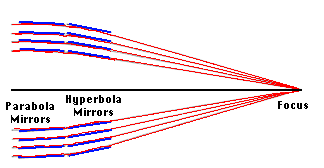
(graphic from http://imagine.gsfc.nasa.gov/docs/science/how_l1/xray_telescopes.html)
To catch as many X-ray photons as possible, X-ray telescopes have concentric cylinders of metal lying inside each other. As the X-ray photons graze past each of these cylinders they are focused at the back of the telescope to be recorded by a detector.
X-RAY MIRROR MOVIE HERE FROM CHANDRA SITE.
(http://chandra.harvard.edu/resources/animations/mirror.html)
X-rays are absorbed by air very easily, that is, they lose their energy quickly via their interactions with the air particles. Hence they cannot penetrate the Earth's atmosphere. In order to observe cosmic X-ray sources, astronomers need send their instruments up above the atmosphere.
The first X-ray experiment was conducted in 1949 whereby the instrument was placed on an Aerobee 150 rocket. This experiment found that the Sun emits X-rays. A big drawback with this method, however, was that the experiment only lasted a matter of minutes. Astronomers needed another way to view the sky longer.

(image from http://wwwastro.msfc.nasa.gov/research/hero/balloon.shtml)
Placing X-ray detectors on helium-filled balloons overcame the time problem as they could stay aloft for hours to days. But, as they can only reach an altitute of 35km, only the most energetic X-rays could be observed. Nevertheless, balloon X-ray experiments detected X-rays from celestial sources for the first time.
The first cosmic X-ray source was discovered in 1962 by a team of astronomers lead by Riccardo Giacconi, was one of the recipients of the 2002 Nobel Prize in Physics. The source was called Scorpius X-1 as it was found in the constellation of Scorpio. It was and continues to be the brightest X-ray source in the sky. Scorpius X-1 is in fact an X-ray binary where a neutron star is accreting matter from a normal star. We will be learning more about X-ray binaries in a future tutorial. With the advent of satellites, astronomers were able to place their X-ray detectors onboard and have them view the sky for as long as the satellite remained in orbit, observing X-rays at many energies. On 12 December 1970 the first X-ray satellite, Uhuru (Swahali word meaning freedom) was launched. During its two year lifetime Uhuru discovered many celestial X-ray sources. Since Uhuru we have sent up many successful X-ray missions. X-ray satellites which are currently in operation above the Earth's atmosphere are the Rossi X-ray Timing Explorer, Chandra and XMM-Newton.