Virtually all information from celestial objects comes to us in the form of electromagnetic radiation, or as it is commonly known, light. When we think of light, most of us think of what we see with our eyes: optical light. But optical light is only a very small part of the electromagnetic spectrum. Electromagnetic radiation covers a large range of energy, including not only visible light, but also radio waves, microwaves, X-rays and gamma-rays.
Electromagnetic radiation has the curious property that it can behave like waves or like particles. Whether one thinks of light as a train of waves defined by a wavelength and frequency (as one commonly does with radio emission) or as a stream of particles referred to as photons (as one often does with high energy radiation) depends on the situation. The wavelength and frequency of light, and the energy contained in a single photon, are related by some simple formulas.
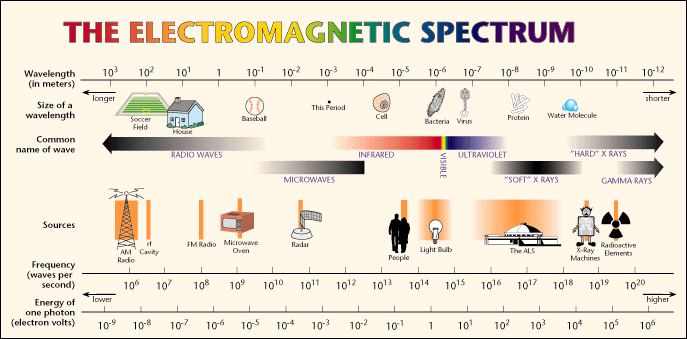
WE PUT OUR OWN EM SPECTRUM HERE
 An astronomical object may look completely different when it is viewed
in optical, radio or X-ray light. The picture on the left shows the
Centaurus A galaxy imaged at various wavelengths. Images such as this
clearly show us that regions which emit light at one wavelength do not
necessarily emit at all other wavelengths. We observe
different components
of the galaxy in the various wavelengths, and all of them are needed to
build up a complete understanding of the source.
An astronomical object may look completely different when it is viewed
in optical, radio or X-ray light. The picture on the left shows the
Centaurus A galaxy imaged at various wavelengths. Images such as this
clearly show us that regions which emit light at one wavelength do not
necessarily emit at all other wavelengths. We observe
different components
of the galaxy in the various wavelengths, and all of them are needed to
build up a complete understanding of the source.
The purpose of an astronomical telescope is to collect and focus electromagnetic radiation. There are particular engineering problems associated with different parts of the electromagnetic spectrum, and these are reflected by the very different kinds of telescopes that are built for each kind of light, as we will see.
How powerful a telescope is depends on a number of different features. The first is the SIZE of the telescope - bigger telescopes collect more light, and therefore can image fainter object. For optical and radio telescopes, the size is given by the diameter of the main collecting area, although in fact the sensitivity of the telescope is proportional to area. For X-ray telescopes, the size is generally quoted in terms of "effective area".
Another important feature of a telescope is its RESOLUTION. The resolution is a measure of how sharp the image is. In many circumstances, the resolution is closely related to the size of the telescope divided by the wavelength of the light being observed (the so-called "diffraction limit"). But for ground-based optical telescopes, the resolution is limited by the atmosphere.
Another important feature of a telescope is the FIELD OF VIEW. This is defined as the area of the sky that the telescope can see at one time. A narrow field of view means that it will take many separate observations to cover a large fraction of the sky, whereas a telescope with a large field of view can operate much more efficiently.
There should be a link here to wave-particle duality.
See the Milky Way imaged at various wavelengths.